The Complete Guide to Answer Engine Optimization (AEO) and GEO
Search is not a list of links anymore. AI search engines write direct answers and synthesized overviews, and the traffic goes to the pages they trust enough to cite. If you do not build your content for Answer Engine Optimization and Generative Engine Optimization, you lose visibility in the new search layer.
- AI Search
- AEO
- Technical SEO
What Are Answer Engines and Why Do They Change SEO?
Answer engines read pages for you and write a synthesized reply, so the click you used to earn now happens inside the answer box. The shift is measurable. When a Google AI summary appeared, users clicked a traditional result in only 8% of visits, versus 15% with no summary (Pew Research Center, 2025).
For two decades the deal was straightforward. You typed a question, got ten links, and did the reading yourself. The engine retrieved documents. You synthesized the answer. That labor has moved.
Now Google’s AI Overviews, Perplexity, and ChatGPT Search read multiple pages, resolve conflicts, and write the answer themselves. Your site becomes a citation at the bottom, or it gets left out. The scale is real: ChatGPT passed 800 million weekly active users in late 2025 (Fortune, 2025).
This guide is the hub for everything that follows. It covers how answer engines work, what makes a page extractable, how citations get selected, the retrieval pipeline underneath it all, and how to measure whether your work is paying off. Start by running your site through the AI Readiness Checker to score where you stand today.
Key Takeaways
- AEO is about extractability (can a model pull a clean fact from your page) and GEO is about selection (does it trust you enough to cite you). You need both.
- When an AI summary appears, the traditional-result click rate drops to 8% versus 15% without one (Pew Research Center, 2025).
- Adding citations, quotations, and statistics can raise a source’s visibility in generative answers by up to 40% (Aggarwal et al., KDD 2024).
- Write for the chunk, not the page. Each paragraph is the retrieval unit, so it has to stand alone.
- Citation share is volatile month to month, so treat any single percentage as a snapshot, not a benchmark.
How AEO Differs From GEO
AEO and GEO are two halves of one pipeline, not synonyms. AEO is the mechanical work of making a fact extractable in one pass. GEO is the reputation work of being the source a model trusts enough to cite. A page can be perfectly extractable and still get skipped, so you need both, in that order.
Think of it as read, then choose. The retriever has to read your page cleanly before the model can choose you over a competitor.
Answer Engine Optimization: Extractability
Answer Engine Optimization asks one question: can a model read your page and pull a clean, quotable fact out of it? Old SEO rewarded long intros and narrative warm-ups. AEO punishes them, because the retriever breaks your page into chunks of a few hundred tokens and ranks each chunk on its own. A chunk that opens with “Before we get into this” loses to a chunk that opens with the answer.
This is a problem you can fix in an afternoon. Audit the page, rewrite the intro, restructure the headings, measure again. Mechanical work, fast feedback.
Generative Engine Optimization: Selection
Generative Engine Optimization asks the harder question: once the retriever has fetched a dozen candidate pages, whose facts does the model trust? GEO is the work of being the source it reaches for, not the one it passes over. The original academic study that named the field showed GEO methods (adding citations, quotations, and statistics) can boost a source’s visibility in generative responses by up to 40% (Aggarwal et al., KDD 2024).
Selection is slower to earn. A brand-new site with flawless AEO still has to build the trust signals that move it into a model’s citation pool.
Citation capsule: Answer Engine Optimization governs whether a model can extract a quotable fact from your page in a single pass, while Generative Engine Optimization governs whether the model trusts you enough to cite it. Both matter: the academic GEO study found these methods can lift source visibility by up to 40% (Aggarwal et al., KDD 2024).
How Does the Answer Engine Retrieval Pipeline Work?
Answer engines run a five-stage pipeline: crawl, index, retrieve, synthesize, cite. Each stage filters what came before. A page that fails the crawl never gets indexed, and a page that gets indexed but never retrieved never gets cited. Understanding where you drop out tells you exactly what to fix first.
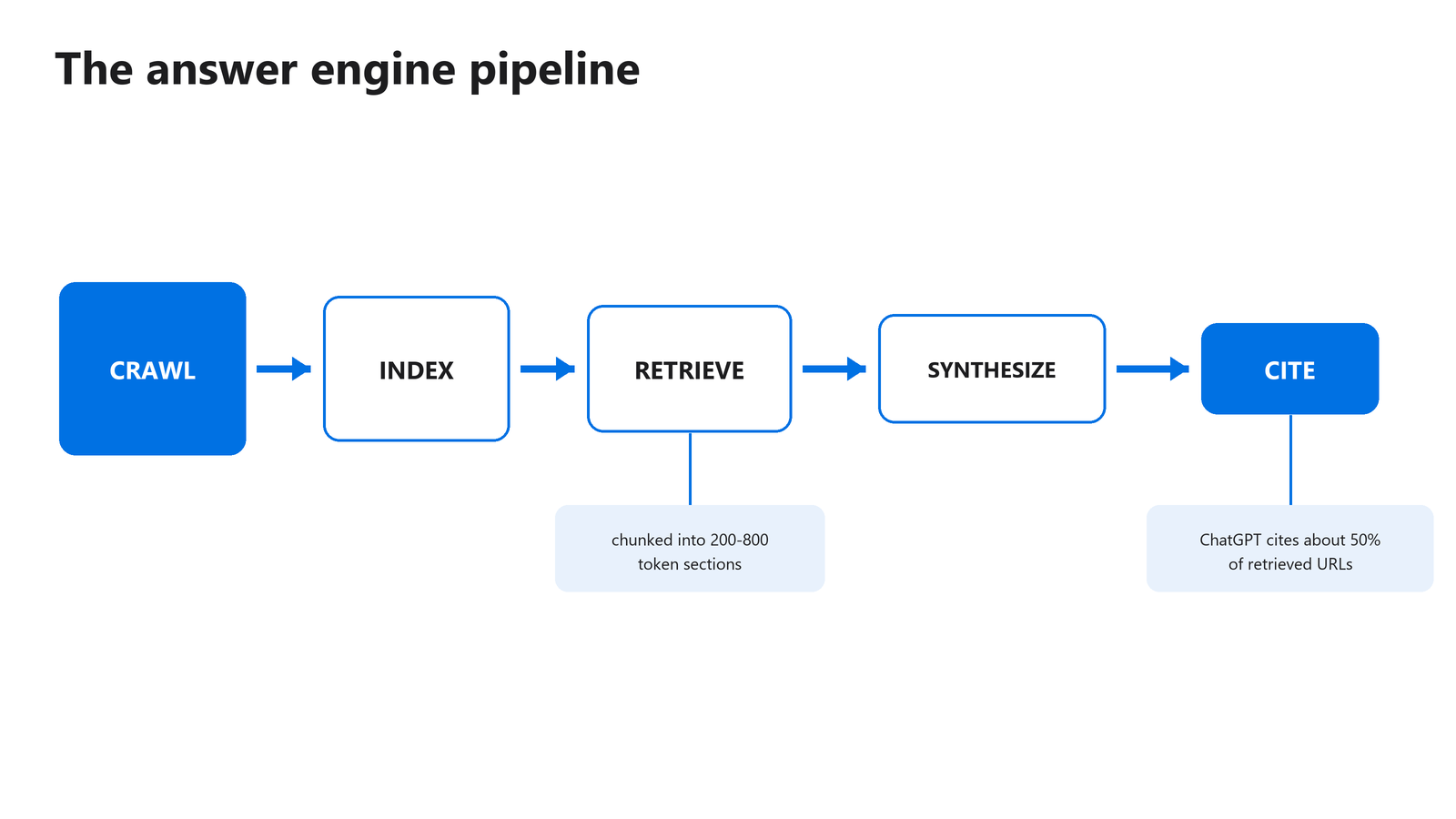
Figure 1: A page has to survive every stage of the pipeline before it can be cited.
Crawl and Index
The crawl stage is binary. If you block GPTBot, ClaudeBot, Google-Extended, or PerplexityBot from public content, you opt out of that engine’s answers entirely. Once crawled, your page gets parsed and stored. Clean HTML, fast delivery, and accurate metadata all decide how completely the page enters the index.
This is where most lost visibility starts, and it is also the easiest stage to verify. The complete checklist for confirming AI crawler access walks through the exact steps.
Retrieve and Synthesize
Retrieval is where chunking happens. The system splits your page into sections, embeds each one as a vector, and matches sections to the user’s question by similarity. The model then reads the top-matching chunks and writes a synthesized answer. Your paragraph competes against paragraphs from other sites, not whole pages against whole pages.
In audits we run, the single most common reason a strong page never surfaces is that its best fact lives in paragraph nine, after eight paragraphs of context-setting. The retriever scores the early chunks, finds filler, and moves on.
Cite
Citation is the payoff stage, and it is selective. An analysis of 1.4 million ChatGPT prompts found the model cites roughly half the URLs it retrieves, with the citation rate strongly tied to source type (Ahrefs, 2025). Search-sourced results were cited 88.46% of the time. Pages with natural-language URL slugs were cited 89.78% of the time, versus 81.11% for opaque URLs.
What Makes Content Extractable for AI?
Extractable content states the answer first, names its subject in every paragraph, and packs usable facts into a small space. The retriever might read only the first two sentences of a section, so those sentences carry the load. Dense, self-contained writing wins because each chunk gets ranked alone, without the context the rest of your page provides.
State the Answer First
Put the answer under the heading, before any context. If the question is “what is the capital of France,” the first sentence is “The capital of France is Paris.” Supporting detail follows. Journalists called this the inverted pyramid a century ago, because editors cut stories from the bottom. The same logic now applies to retrieval chunks.
Here is the difference in practice. A weak opener buries the fact:
When it comes to hreflang tags, there are many things to consider, and best practices have evolved over the years.
A strong opener leads with it:
Hreflang tags tell Google which language and region a page targets. Add one tag per region in the head, including a self-referencing tag.
The second version is shorter and holds three extractable facts. Test your own pages with the Answer Extractability Checker, which pinpoints the chunks an extractor will actually pull.
Write Self-Contained Paragraphs
Every paragraph should survive being yanked out of context. Avoid openings like “It is effective because” or “This approach works well when.” Name the subject again so the paragraph stands alone as a quotable answer. Read your page out loud, paragraph by paragraph. If one starts with a pronoun pointing back to the paragraph above, rewrite it.
Cut the Filler, Keep the Signal
Filler dilutes the signal density of every chunk. Before you publish, run the draft through the AI Text Humanizer to strip warm-up sentences and expose the load-bearing claims. Dense does not mean dense prose. It means dense signal: one idea per paragraph, no padding, and the fact stated plainly.
Citation capsule: Extractable content leads with the answer, repeats the subject in every paragraph, and survives being pulled out of context. This matters because retrieval systems rank each chunk independently, and ChatGPT cites only about half the URLs it retrieves (Ahrefs, 2025).
How Do You Earn AI Citations?
You earn citations by combining extractable content with trust signals: full topical coverage, confident claims, easy-to-quote facts, and external validation. The model has already read a dozen candidates by the time it picks. Your job is to be the most complete, most quotable, and most credible option in that set, not just a correct one.
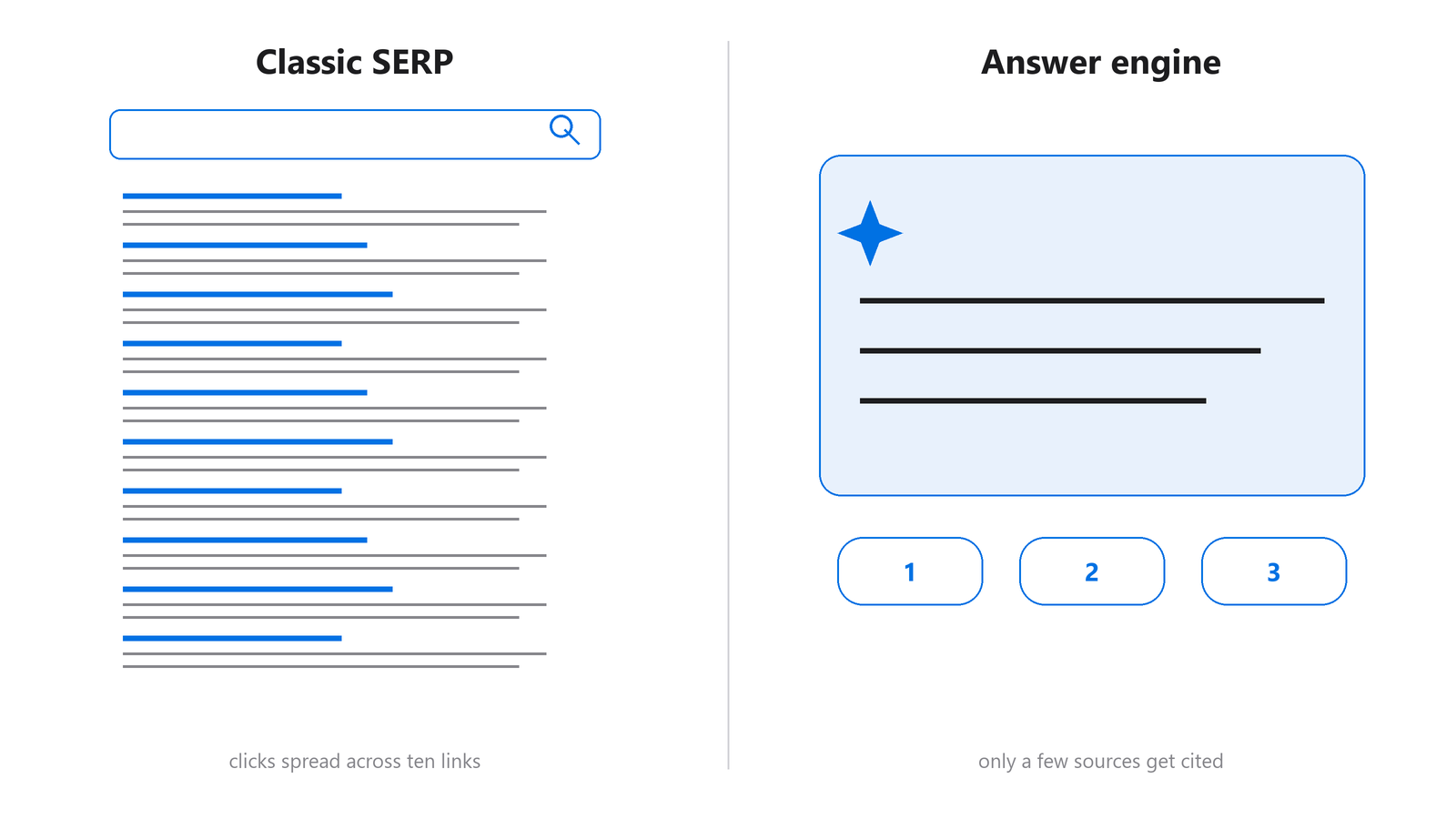
Figure 2: The classic SERP rewards ranking. The answer engine rewards being one of a few cited sources.
Cover the Topic Completely
Thin pages lose to comprehensive ones even when both contain the correct answer. Include the subtopics, terms, and supporting facts that naturally belong together. The Topical Authority Mapper shows where your coverage is thin so you can fill gaps before a competitor with a fuller page takes the citation.
State Facts With Confidence
Hedged writing makes content less useful to a model that needs a concrete claim. “This might generally tend to be the case” gives the model nothing to quote. Where you know the answer, say it plainly, then list the exceptions separately. Statistics, version numbers, dates, and named entities are all easy to cite, so put them in.
Build External Validation
Most teams treat citation as a content problem and stop there, but the durable advantage is reputational. The domains that consistently win AI citations are the ones models already see referenced elsewhere. A 13-week study of 230,000 prompts and over 100 million AI citations found Wikipedia and Reddit lead consistently, while individual domain share swings hard month to month (Semrush, 2025). Reddit’s citation frequency in ChatGPT fell from roughly 60% to 10% between early August and mid-September 2025.
Before anything else, run your top commercial pages through the Citation Readiness Analyzer to see whether each one is likely to be cited or skipped. For the page-by-page rewrite process, see how to optimize your site for AI citations.
Formatting Content for Retrieval Chunks
Format for the chunk, not the page. Retrieval systems split text into sections of roughly 200 to 800 tokens and match each one to a question independently. Each paragraph is a retrieval unit, so write so a paragraph pulled from section six still answers a question well in a context the reader never saw.
Use Dense Formats
Lists and tables hold a lot of usable detail in a small space, which helps when a system pulls only a short chunk. A five-row comparison table can be worth a thousand words of prose, because the retriever can quote the whole table and the model can summarize a single row. Dense formats are the highest signal-per-token content you can write.
Use Exact-Match, Question-Shaped Headings
Do not write clever headings. If a user wants to reset a router, write “How to Reset the Netgear Nighthawk Router,” then answer immediately. Heading-as-question pattern matching is one of the strongest signals retrievers use. Search the question yourself across Google, ChatGPT, and Perplexity, note the exact phrasing each surfaces, and use the winning version.
Make Internal Context Explicit
Internal links tell crawlers how your site fits together, and they compound. Every new post that links to your pillar page raises the pillar’s authority. If you publish a hub on AEO, your related posts should point back to it, and the hub should point out to them. That structure also helps a model understand which page on your site is the canonical answer for a topic.
Citation capsule: Retrieval systems chunk pages into 200 to 800 token sections and match each one to a query independently, so every paragraph must stand alone. Pages with natural-language URL slugs were cited 89.78% of the time, versus 81.11% for opaque URLs (Ahrefs, 2025).
How Do You Measure AEO and GEO Performance?
You measure AEO and GEO with four tracks: technical health, extractability, topical coverage, and citation share. A keyword rank report no longer tells the full story, because the metric that matters most is whether your domain appears in AI answers for the queries you care about. The catch: citation share is volatile, so treat each reading as a snapshot.
Track Citation Share as a Snapshot
Citation share is how often your domain appears in AI Overviews, ChatGPT, Perplexity, and Claude answers for your target queries. The figures move fast. Ahrefs measured a 34.5% lower click-through rate for the top-ranking page when an AI Overview is present, across 300,000 keywords (Ahrefs, 2025). A later follow-up reported the impact had grown further, which is exactly why you read trends, not single numbers.
In our own weekly spot checks, ten queries run across three engines is enough to tell direction within a month. We log which engine cited us, the exact query, and the competing sources. The pattern that repeats: pages we rewrote for extractability entered the citation pool within two to four weeks, while untouched pages stayed flat.
Pin Down the Technical Basics First
Before you chase citation share, confirm the page is even eligible. One stray noindex tag, a canonical pointing at a 404, or a blocked AI user-agent erases months of content work. Audit these on a schedule, not just before launch. The AI Readiness Checker scores crawl access and content structure together, so it is the fastest single check to run before a release.
Watch for Cannibalization
If three pages answer the same question slightly differently, the retriever sees three half-authoritative answers instead of one strong one, and models hedge by citing none. Consolidate overlapping pages into one canonical answer. One strong page beats three weak ones in every retrieval system we have tested.
FAQ
Is AEO replacing SEO?
No. AEO extends SEO, it does not replace it. The technical foundation (crawlability, clean metadata, fast delivery, internal links) is the same work both disciplines depend on. What changes is the content layer: you now write for extraction and citation, not just ranking. A page that ranks well but hides its answer will still lose the citation.
Do AI summaries really reduce my traffic?
Often, yes, for informational queries. When a Google AI summary appeared, the traditional-result click rate fell to 8% versus 15% without one, and only 1% of users clicked a source link inside the summary itself (Pew Research Center, 2025). Commercial and navigational queries are less affected, but the trend is clear.
How long until AEO changes show up in citations?
In our experience, two to four weeks for extractability fixes on pages that are already crawled and indexed. Selection-side gains, the GEO half, take longer because they depend on accumulating trust signals. Mechanical fixes are fast. Reputation is slow. Plan your roadmap so the quick wins fund the patient work.
Should I block AI crawlers to protect my content?
Only with intent. Blocking GPTBot or PerplexityBot removes you from that engine’s answers entirely, which is a visibility decision, not just a privacy one. If you want citations but not training use, content-policy controls let you allow retrieval while restricting training. Review the rules quarterly, because stale blocks from 2023 silently cost visibility.
What is the single highest-impact change I can make today?
Rewrite the opening of your top ten pages so each section states its answer in the first sentence. This is the cheapest, fastest AEO win, and it directly improves chunk-level retrieval. Confirm the result with the Answer Extractability Checker and verify crawl access is not silently blocking the gains.
What To Do Next
Answer engines are already reading your pages. The question is whether they find a clean, quotable answer or a wall of warm-up text. Start with one scored audit, fix the technical basics, then rewrite your highest-value pages to lead with the answer.
Run your site through the AI Readiness Checker to score crawl access and content structure in one pass. Then go deeper with the two sibling guides in this cluster: how to optimize your site for AI citations for the page-by-page rewrite process, and agent readiness for the protocol layer that arrives next.